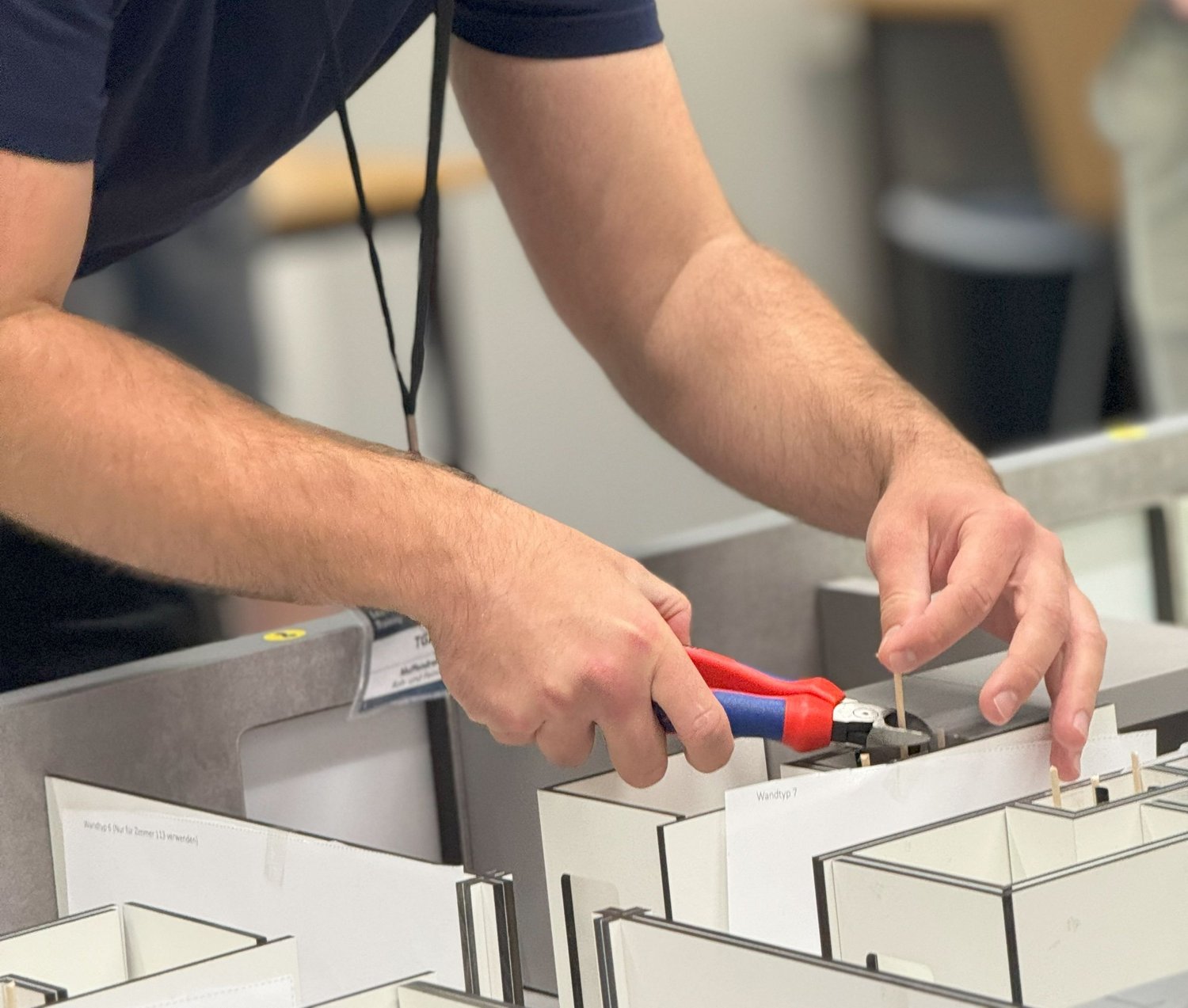
A full-day seminar on lean construction gave students the opportunity to learn the principles and methods of the approach in practice. The central question: how takt planning and control make construction projects more structured and more efficient.
How the seminar ran
It opened with a brief introduction to the basics: reducing waste, value creation, continuous process improvement. Then came the practical part, the Lean Construction Hotel Simulation.
The Lean Construction Hotel Simulation
In the simulation, participants planned and built a construction project, in this case a hotel. This allows lean principles to be tested in a safe environment.
- Format: Several rounds of increasing complexity. In each round, work processes were organised and improved using takt planning and control.
- Goal: To make tangible what better planning, shorter lead times and closer collaboration do for a project.
- Learning from mistakes: Poor alignment and delays in the first rounds were analysed and eliminated in the following rounds using lean methods.
Takt planning and control
A core focus of the seminar was takt planning and control. It makes projects more predictable: clearly defined sequences, synchronised processes, continuous monitoring. The method was presented and then applied directly in the simulation.
Feedback
The mix of theory and practice landed well. Many participants highlighted that they were able to apply lean construction themselves and encountered the typical problems of construction practice along the way.
Conclusion
Lean construction can make construction projects more efficient and more structured. Theory alone is not enough for that; the methods have to be practised. Formats like this simulation do exactly that.