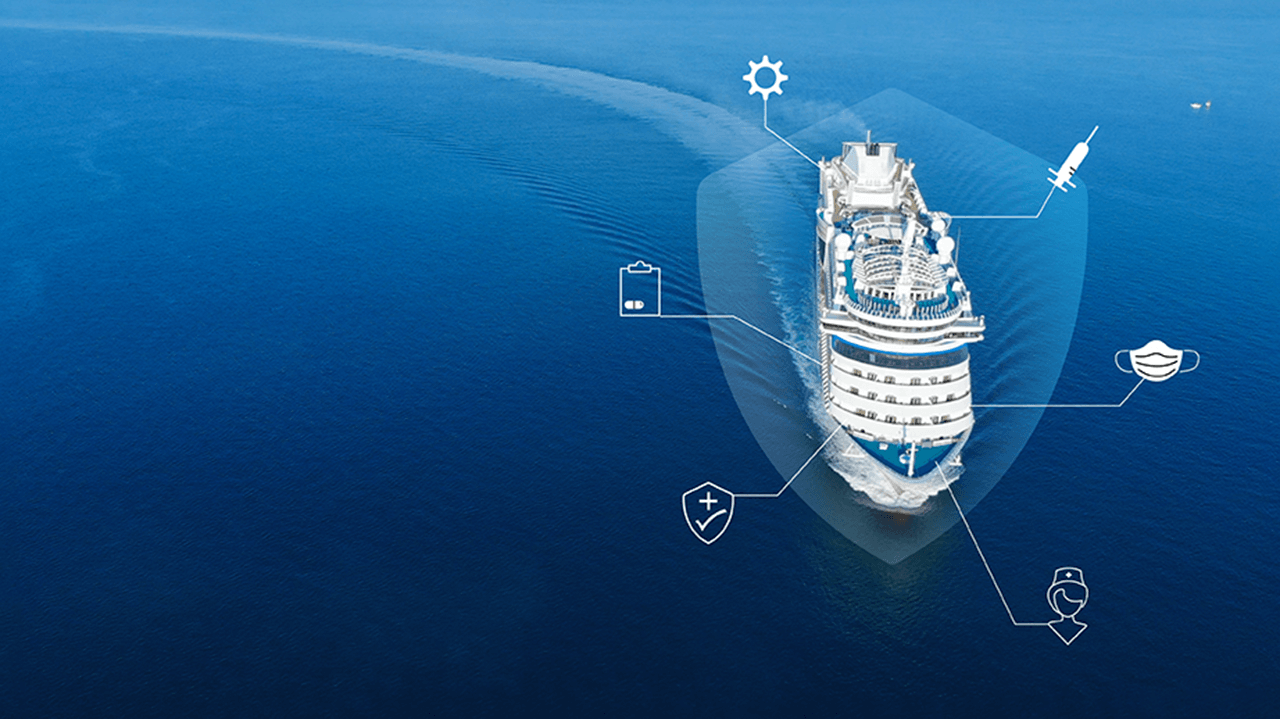
Now is the time for strategic efficiency. Filip Specht has experience dealing with epidemiological challenges on board. The chief engineer of Lean Maritime GmbH has been at sea as a third-generation merchant marine officer for thirty years now. We asked him how a lean reorganisation can guide cruise companies successfully into the new future:
How does lean management help the cruise industry through the crisis?
“As the Covid-19 pandemic flattens out, a new era — defined by change — begins for the cruise industry: a restart into unknown and uncharted territory. For owners and operators it is now mainly about reducing costs while maintaining service quality. That is exactly what a lean reorganisation delivers. We analyse the processes on board and identify improvement potential. Using lean principles, we design both the necessary new and the existing workflows efficiently. The result: a clear improvement in costs and performance plus a stable process structure that absorbs upcoming uncertainty as well as possible.”
How can operators and owners lift productivity despite strict new regulations?
“Where efficiency improvement using lean logic was once a wonderful option for cost and performance optimisation, it is now an absolute must to survive economically. Many new regulations and the additional tasks they bring are now facing a reduced crew at lower utilisation. Realistically, we have to take every flow apart, examine it, put it back together tightly and roll it out in a series of short pilots. Throughout, we orient ourselves strictly to value creation, and that is how we improve it. The lean understanding within the crew is essential in this. Staff training is therefore among the central building blocks of lifting productivity.”
To what extent is it possible to keep service quality at a high level with reduced crew?
“It is the guests who judge service quality. We collect data from their perspective and look at exactly what they expect, need or want on board. The goal is to cover those concrete needs and at the same time eliminate unnecessary or excessive activities. In parallel we establish the procedures of the new hygiene rules in a lean and tailored way. As needed, we either design the new processes unobtrusively, or we present them openly — perhaps even with a show character — as added value for the community on board. We follow a holistic planning and procedure approach that meets emotional and regulatory requirements and at the same time can react flexibly to short-term changes.”
So agile management complements the lean logic of the upcoming realignment?
“Yes. An agile mindset supports lean methodology beautifully in this situation. The journey into the unknown demands robust, not rigid structures. As medical insights evolve, requirements can change from week to week. A current example is aerosols. They demand different hygiene measures than smear or droplet infections. New rules therefore have to be integrable into the existing processes at any time — without long tests and training. We therefore implement tools and methods on board that help adjust routines quickly, in a planned, efficient and flexible way.”
Why is hygiene safety decisive? What is the big opportunity?
“The cruise industry has long carried the stigma of being a petri dish full of viruses and bacteria. That is entirely unjustified. The numbers refute these claims, yet the emotional assumptions still circulate publicly. The big opportunity of the heightened hygiene measures now lies in giving the cruise industry a cleaner, healthier and at the same time more realistic image. That goal calls for a shared mindset. If everyone works hard to prevent infections — be it Covid-19, flu or a stomach illness — on board and communicates accordingly, we can build solid trust in onboard healthcare among potential guests.”
Pragmatically: which processes should be reorganised first?
“First, it is important to retrace the guest journey — from the moment they decide on a cruise. The health dimension also dominates this analysis. As early as the booking, the operator has to know whether the guests are really fit to travel and whether there might be pre-existing medical conditions. On board, every point of direct or indirect interaction between guest and ship has to be examined. Good communication will also be decisive here, to implement new standards and to give guests a good feeling. The subsequent reorganisation of the individual departments is staggered — in the spirit of cost reduction — by their work intensity.”
Why is it important to design the new processes strategically efficiently from the start?
“Designing processes from scratch, training them and implementing them is significantly easier and faster than interrupting routines in order to change them. We think the flows through up front — not only once they are well-established. With new procedures we have the chance to install lean, agile and error-proofed processes according to a correct, detailed plan. That saves a lot of effort and time.”
How sustainable is the lean reorganisation beyond the crisis?
“The fundamental idea of lean logic is continuous improvement. If we have a vision that enriches our company, we will continuously optimise our business towards it. Given the large number of processes in the operation of a cruise ship that are not value-adding, we have plenty to do beyond the crisis to improve them sustainably with lean management.”