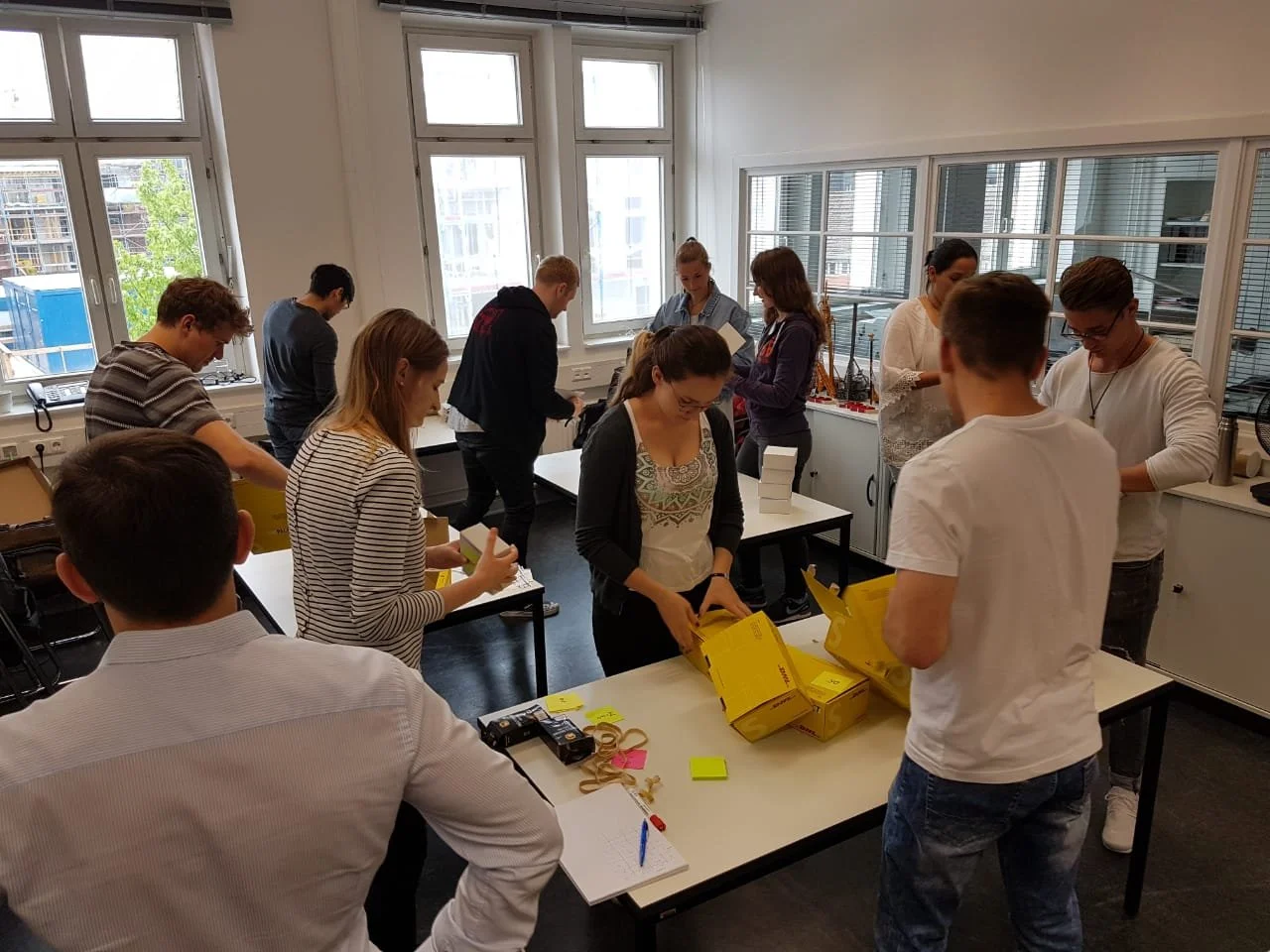
In the summer semester of 2019, Lean Maritime partners Theo Herzog and Holger Segler taught students at the Institute of Geotechnical and Construction Engineering at TU Hamburg the idea and methods of “Lean Construction”.
The course in the Construction Processes module of the master’s programme in civil engineering consisted of a lecture on the theory and a practical exercise. With a cardboard simulation, the theory became tangible for the future civil engineers. At four stations — logistics, pre-assembly, final assembly and quality assurance — around 25 students experienced how the principles of “takt”, “pull” and “flow” lead to less waste, shorter lead times, more stable flows and predictable results.
Takt, pull and flow in the seminar room
“A simulation like this shows in simple form what often happens in production operations,” says Theo Herzog. “If, for example, logistics supplies the assembly line in an unsteered way, the costs of the entire production go up — through unnecessary search time, extra storage area, material damage and longer waiting times. If logistics, on the other hand, only delivers regularly what is needed at that moment, the sequence of production steps is preserved and waste is minimised.” The students experienced this effect within a few hours by delivering, folding, filling and inspecting cardboard boxes. In four runs they tried different methods, took the times, changed the flows, structured the work steps, monitored utilisation and optimised the takt.
Civil engineers of the future
The students benefit from Theo Herzog’s decades of experience. They recognise waste in a value chain immediately. “In the exercise we are only folding cardboard boxes,” says Holger Segler. “But in their later working life these same people will be on a construction site as site managers, and will have to coordinate the flows of up to thirty partner firms.” Their theoretical and practical lean-construction knowledge from the summer semester of 2019 will then certainly help them. By the end of the simulation, the students could in any case demonstrate — after a few optimisation steps — an efficiently steered value chain with clearly structured, controlled and cost-optimised production flows.